
Every Saturday, the boy boarded at Maple Street with a folded piece of paper in his coat pocket. He sat behind the driver, kept his eyes on the window, and got off at the final stop beside a brick building with a blue awning.
Mr. Harris had driven that route for eleven years. He knew the regulars by their stops and their habits: the woman who always carried tulips, the man who read the sports page upside down, the teenagers who moved to the back as soon as the bus pulled away. The boy’s name was Leo. He had told Mr. Harris on his third ride, though he said little else.
One rainy Saturday, Leo climbed aboard with wet sleeves and no fare card. He searched his pockets, then looked up, embarrassed.
“I can walk,” he said.
Mr. Harris saw the damp paper in Leo’s hand. “You can ride today. Sit down before you catch a cold.”
Leo took his usual seat. At the last stop, he thanked the driver and hurried toward the blue awning.
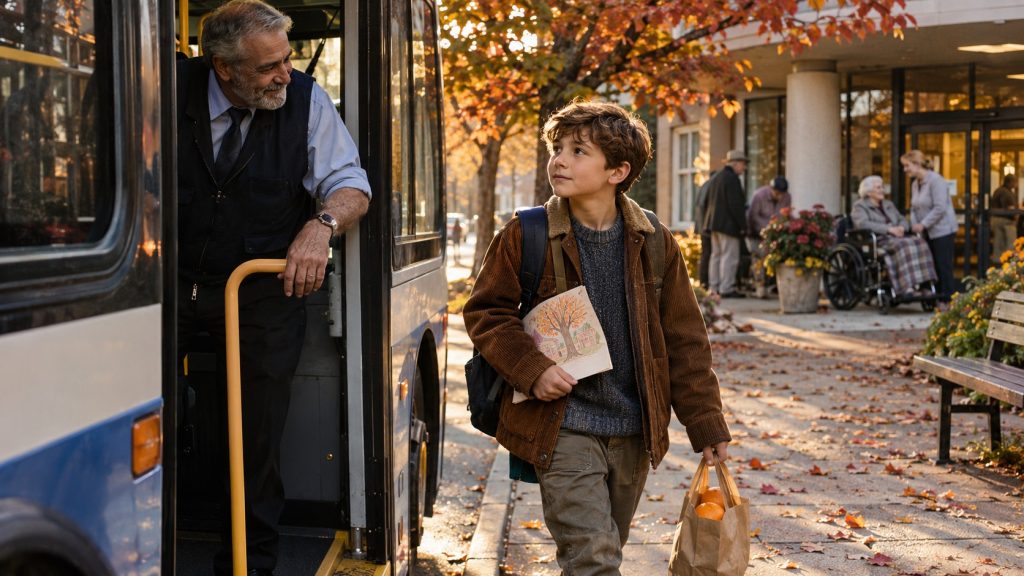
The Saturday route
The next week, Leo had a fare card. He also carried a small paper bag that smelled like oranges. Mr. Harris watched him cross to the same building. A staff member opened the door and waved him inside.
“Who are you visiting?” Mr. Harris asked as Leo stepped down.
“My grandma. She’s learning to talk again.” Leo tapped the folded drawing in his pocket. “Some days the words get stuck, so I bring pictures.”
The building was a rehabilitation center. Leo’s grandmother, Ruth, had suffered a stroke in the spring. His mother worked weekend shifts at a grocery store and could not always take him. When she did, the trip required two buses and almost an hour each way. Leo had started going with a neighbor who worked at the center, but that neighbor’s schedule had changed.
Leo mapped the route in a school notebook, marking the bakery where the bus turned and drawing a star beside the blue awning. His mother kept it to explain the trip to the neighbor who sometimes took him. Leo worried Ruth would think he had stopped visiting if a Saturday passed. His mother promised they would find a safe way to keep visiting.
Mr. Harris looked at the route map. The bus stopped across the street from the building. He wondered whether the boy was making the trip alone, then remembered the woman who met him inside. He decided to ask the dispatcher what the rules allowed before assuming anything.
A plan made with permission
The following Monday, Mr. Harris spoke with his supervisor. The center confirmed that Ruth’s daughter had approved Leo’s visits and that a staff member met him at the door. The transit office helped the family arrange a youth pass and gave them the right information about the route.
No special bus rule was needed. Mr. Harris simply made sure he kept to the schedule, and the center’s receptionist knew which Saturday run Leo was on. If Leo did not arrive, the staff would call his mother. It was a small plan, but it gave everyone peace of mind.
On the next ride, Leo handed Mr. Harris an orange from the paper bag.
“For the driver,” he said. “Grandma says you help me get there.”
Mr. Harris accepted it. “Tell her I’m glad to.”
At the center, Ruth sat by the window with a blanket across her knees. Leo unfolded his drawing: a bright blue bus, a woman with silver hair, and a round orange sun. Ruth studied it. Her hand moved slowly over the page.
“Bus,” she said.
Leo’s face lit up. “That’s right. And that’s you.”
Ruth touched the little figure beside the bus. Then she looked at him and formed another word, quiet but clear.
“Leo.”
The picture on the dashboard
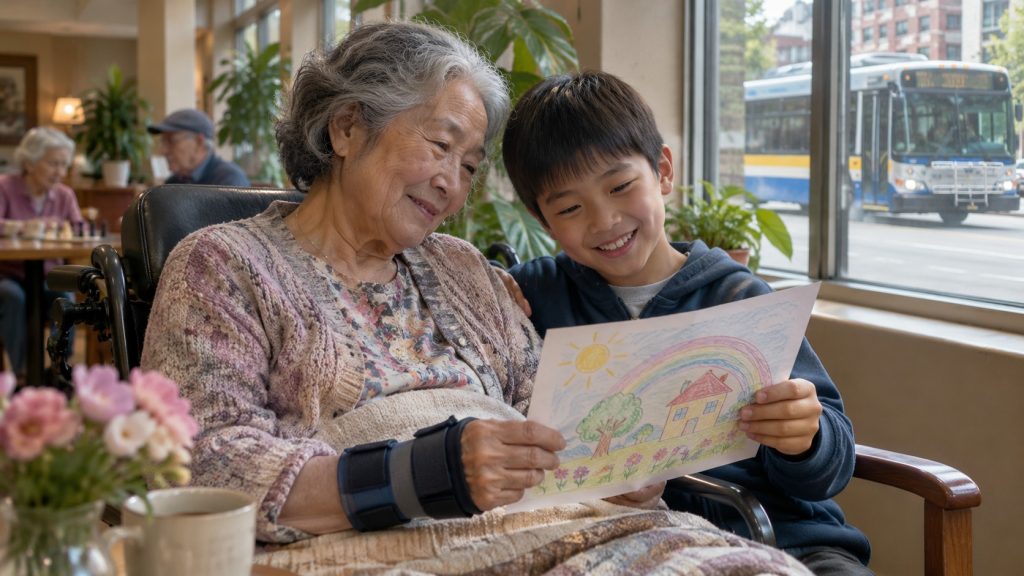
After that, Mr. Harris kept a copy of Leo’s drawing tucked beside the route schedule, with his mother’s permission. The original stayed in Ruth’s room. Each week, Leo brought a new one: a row of autumn trees, a paper boat, a cat wearing a crown.
Some Saturdays Ruth could say a few words. Some days she only smiled or held Leo’s hand. He learned not to measure a visit by how much she said. Sometimes he read her the labels on the pictures. Sometimes they sat together while the afternoon light moved across the floor.
By December, Leo no longer hurried off the bus. He thanked Mr. Harris, then waited for the receptionist to come to the entrance. The driver watched from the mirror as they greeted each other.
One afternoon, Ruth’s hand trembled as she pointed toward the window. Leo followed her gaze. The bus was waiting at the curb, its lights glowing in the early dark.
“Your ride,” he said.
Ruth squeezed his fingers. “Saturday.”
It was one word, but it held a promise they could both understand. Mr. Harris closed the doors and pulled back onto the route. In the schedule holder beside him, the blue bus drawing stayed in view—a reminder that a small, ordinary trip can become part of someone’s way back to the people they love.