
While Bridgerton is a unique imagined version of a period drama, they are still trying to portray the Regency Era. And we love it. The costumes are stunning, the cast is gorgeous, and the romance and the drama are impeccable. But when it comes to historical accuracy of a period piece—some mistakes have been made. A few are simply overlooked little details we could forgive, but some just make little sense for the time period. Let’s take a closer look.
1. White Wedding Gown
Daphne Bridgerton’s wedding dress might look like it’s appropriate for the Regency era in style, but there’s a small catch that isn’t exactly usual for the period. You see, wearing a white dress as your wedding gown wasn’t the norm back in the day. High society usually dressed in rich colors for their wedding and accessorized heavily with jewels, gold embroidery, and even furs to show off their status and how wealthy they are. White only became popular after Queen Victoria wore a white dress for her wedding to Prince Albert in 1840. Before that it was basically unheard of. So if the show was aiming for historical accuracy, Daphne wouldn’t have worn a white dress to marry Duke Hastings.
2. Modern Grapes
This is such a tiny detail that’s it’s almost impossible to notice unless you’re looking for it. However, if you pay attention to the food on the show, you might notice a scene in season one that features a fruit bowl that contains seedless grapes. As innocent as this detail is, it’s not historically accurate, because sexless grapes literally didn’t exist until the 1870s. So the Bridgerton family couldn’t possibly get ahold of seedless grapes in 1813 for love of money.

3. Smoking Habits
Several characters on the show (Anthony, Eloise and Benedict) are shown smoking cigarettes a few times. The thing is, smoking wasn’t popular among the upper classes. You see, the smell would linger on the clothes and the hair, so they considered snuff a lot more convenient. And snuff was considered more posh back in the day.
4. Corsets
There’s a scene where one of the daughters of the Featherington family is being forced into a corset so that her waist could be the size of an orange and a half. That makes absolutely no sense in this time period. This wasn’t the time for tight corsets at all. Empire waistlines were all the rage then, and those are very forgiving, and women generally only wore stays at the time for the purposes of support and as an undergarment. So yeah, squeezing yourself into a corset wasn’t a thing during the Regency era.
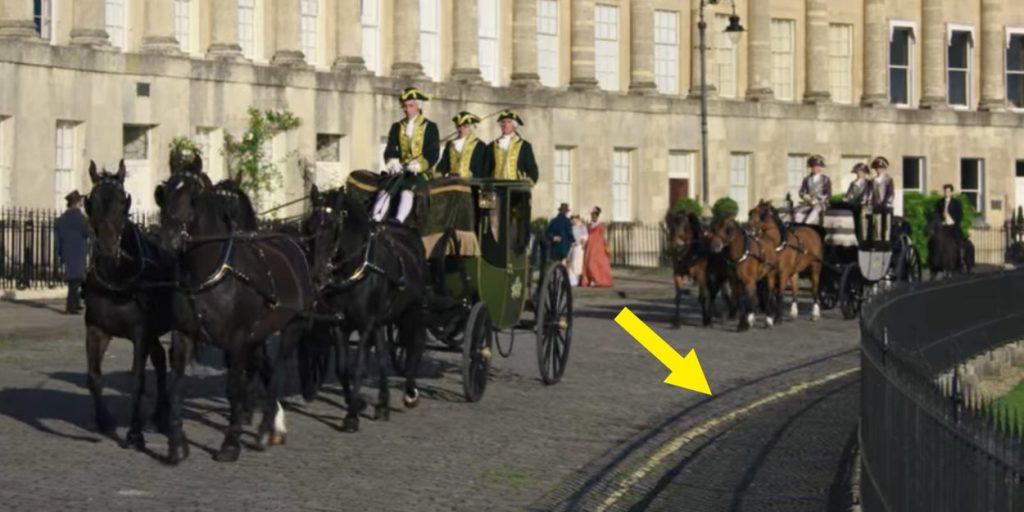
5. Yellow Lines
This is a small detail, but once you notice it, you can’t unsee it. The yellow traffic lines on the road were only introduced in the 1950s, they simply didn’t exist back in the day, and they look very out of place with the Regency decorations and the costumes. Takes you right out of the moment and makes you realize it’s modern-day roads, doesn’t it?
6. Simon’s Stubble
Simon Basset is a fan favorite for many reasons. The man actually grows as a character, he’s extremely hot, and that stubble is very sexy. Am I right or am I right? But unfortunately the stubble wasn’t a hot look for a Duke in that time period. Wealthy men were always expected to be clean-shaven and baby smooth.
7. Modern Doorbells
A small detail again, easily overlooked, but we did notice modern doorbells in some scenes. These, of course, did not exist at the time. The first electric doorbell was actually invented in 1831 by an American scientist, but doorbells only became popular and widespread only a hundred years later.
8. Simon Would Have Wanted An Heir
Simon not wanting children is one of the major plot lines in the show. It’s said that he didn’t want kids because he didn’t want them to inherit his speech impediment, and also because he didn’t want to chance having a rocky relationship with them like he did with his father. As understandable as those reasons are in modern times, back in the day Simon still most likely would’ve wanted at least one child so that he’d have an heir to inherit his land and to ensure the family line continues.